1/20/14

To jump or to fly?


     "...the author who attempts to organize space while neglecting time is venturing into a field in which materials and the tools - paint, canvas, stone, metal, wood, and camera lens - are more effective than language. He is working in two or three dimensions instead of four and is thus evading what seems to me a more difficult challenge and a greater opportunity for innovation."
     This is Malcom Cowley's (one of Malcom Cowley's) attacks on the avant-garde, and specifically Robbe-Grillet's idea of the "new novel" and Andy Warhol's a in Cowley's essay A Defense of Storytelling.
     It seems to me that he has a point, though a decidedly conservative one - for after all, a writer must be able to write whatever a writer wants to write, right?
     But it's true, one must admit, that one advantage writing has over, say, painting, sculpture, music even, is time. The writer has the ability to lead the reader through maze after maze, the seeing forest and the hearing field, across the street and up the stairs, to open the door, to enter the room, to walk over to the window, to open the window, to step out onto the ledge, to look down, to sigh, and then, perhaps, to go back in or to jump or to fly.

1/7/14

Sacco and Vanzetti and Rexroth

                                          Many men, a long time.

12/27/13

Writing Is Wrought

the proper way to light a pipe
     "I am an artisan. I need to work with my hands. I would like to carve my novel in a piece of wood."
          - Georges Joseph Christian Simenon

12/11/13

Walled In

Thoreau moments after losing his mustache in the woods.

     "It is a ridiculous demand which England and America make, that you shall speak so they can understand you."
          - Thoreau (in Walden) offering a comment on (the intelligence of) his readership.

11/18/13

The Singing Truth

Cuetzpaltzin after having his poems misunderstood by Cortes.


He goes his way singing, offering flowers
And his words ring down
Like jade and quetzal plumes
Is this what pleases the Giver of Life
Is that the only truth on Earth?

          - Ayocuan Cuetzpaltzin (Nahuatl poet, 15th century)
   
     The tlamatinime people of precolonial Mexico suggested that immutable truth is by its nature beyond human experience. Their philosophers believed that, because we are mortal, we cannot know Truth. If we cannot grasp eternity, then we cannot grasp eternal truth.
     The passage above is a kind of poetics solution to this riddle. We cannot know truth, but we can sing the things around us. And through singing gain access to truth.
     The poet continues:

          From whence come the flowers that enrapture man
          The songs that intoxicate, the lovely songs?
          Only from the innermost part of heaven.

     Through art we access grace, or other, or truth. Perhaps this seems obvious, or cliche now. But it strikes me that this was a realization of an early 15th century poet from subtropical north america, one of millions doomed by the fast approach of material Europe.

11/7/13

Poet as Chicken


     "The man who has fed the chicken every day throughout its life, one day wrings its neck instead, showing that more refined views as to the uniformity of nature would have been useful to the chicken."
          -Bertrand Russel

10/10/13

Issue VI Now Available!

Arreguin's The Bull Got Into the Flower Garden

     Issue VI is now available via this website (see "Buy a Copy" button), with work by Jeff Encke, Annie Chou, Greg Bachar, Nadine Maestas, Fred Sasaki, Rachel Kessler, Greg Bem, Marissa F. Baum, and Simone Sachs. Art by Alfredo Arreguin.
     Please buy a copy! All proceeds go to the next issue of struggling literary magazines based in Seattle that rhyme with 'crazed goy.' You're gonna love it!

9/27/13

Neglection Slip

Ms. Rich
     When Adrienne Rich was editing The Best American Poetry (1996), she chose a couple poets who she could not locate. She mentioned them in her introduction, even though - without their permission -  she had no choice but to leave them out of the anthology. When the book came out, at least one of them wrote back, upset by seeing her name in the introduction, yet not being included in the anthology.
     Rich responded:
     "A poem often becomes a kind of commodity in the competitive literary world of curriculum vitae, though I deplore the fact. I would be very sorry if either this mischance, or your numerous recognitions, were to get between you and the life of poetry, which is an art, not a competition, an art demanding self-discipline and apprenticeship, often through very unencouraging circumstances, for stakes which have nothing to do with the market."

9/11/13

Meaning as Poverty

What Sontag means by having her photograph taken in a doorway is that... what she is trying to say is... Oh! and by wearing her hair down, well that is obviously a nod toward... And the leather jacket! Anyone can see that by rocking the leather jacket she is making a statement about... 
     "Interpretation is the revenge of the intellect upon art. Even more, it is the revenge of the intellect upon the world. To interpret is to impoverish, to deplete the world - in order to set up a shadow world of 'meanings'."
     - Sontag (from "Against Interpretation," which is required reading!)

9/5/13

Bang.

Phoebe Annie Oakley Mozee

     Just thought you'd like to see how happy Annie Oakley could be.

8/25/13

singing and dancing and talking about it too

Rodin's Poet and Critic.
     Here are a few quotes from A.R. Ammons re critics and art making. They are taken from his introduction to The Best American Poetry 1994. The entire introduction is worth reading yes.

     "There is no reason ever in the world for the critic and poet to be at odds, and for the following reason: the primary motion of the poet is to put things together and touch a source that feels like life, at times even more powerful than life. It is a synthesis of analogies and associations that promotes, in the best hands, and even when disjunctive, a sense of renewed vitality. That is what one feels. That is a fact whether noticed by poet or critic. The critic makes another kind of synthesis; his or her synthesis comes as a result of what can be added up after taking things apart. What is added up, as in dissertations and works of critical discourse, is thought to be subtler and finer than the work that gave rise to it. But that cannot be, because the two modes of thought, the creative and the analytical, are not comparable; they are apples and oranges."

     "Thousands of papers may be written about Rodin and many of them may know more about Rodin than Rodin did but they will not resemble sculpture. Rodin made the sculpture. No one else did."

     "We will dance and sing. Sometime later we will talk about singing and dancing, and in that effort, we will need all the help we can get from the critics or anyone else."

8/1/13

Poetry's Dead And Jazz Ain't Cool

Jazz may not be cool, but that pink tie is.
     Here's a link to Nicholas Payton's blog and his poem on why jazz ain't cool: necrophilia. Some of his thoughts can be applied to poetry as well ... right?

7/25/13

Dead Letter Text


     "The logos of a bad writer throws words together in no order at all, perhaps beginning at the point where it should end and wholly ignorant of organic sequence. You can enter this logos at any point and find it saying the same thing. Once it is written down it continues to say that same thing forever over and over within itself, over and over in time. As communication, such a text is a dead letter."
     Anne Carson (in Eros the Bittersweet)

6/13/13

Baudelaire's Doggie Bag

Baudelaire with dog hidden in shirt.
     Here's Baudelaire's "The Dog and the Scent Bottle"

     Come here, my dear, good, beautiful doggie, and smell this excellent perfume from the best perfumer of Paris.
     And the dog, wagging his tail, which I believe is that poor creature's way of laughing and smiling, came up and put his nose to the uncorked bottle. Then, suddenly, backed away in terror, barking at me reproachfully.

     "Ah miserable dog, if I'd offered you a bag of shit you would have sniffed at it with delight and perhaps devoured it. In this you're like the public, which should never be offered delicate perfumes that infuriate them, but only carefully selected garbage."

6/12/13

Lips or roots?

whose lips as fat as roots
     "I love the world of wind and foliage / I can't distinguish lips from roots"
        -Neruda

6/5/13

Lizard Eyes

Still with eyes.
"I came into this world with eyes / And I'll leave without them."
     -Lorca.

5/4/13

Love Lavished

The thick smear of a blue spot.
     "The true sexuality in literature - sex as a positive aesthetic quality - lies not in any scene and subject nor in the mere appearance of a vulgar word, not in the thick smear of a blue spot, but in the consequences on the page of love well made - made to the medium which is the writer's own, for he - for she - has only these little shapes and sounds to work with, the same saliva surrounds them all, every word is equally a squiggle or a noise, an abstract designation and a crowd of meanings as randomly connected by time and use as a child connects his tinkertoys. On this basis, not a single thing will distinguish 'fuck' from 'frais du bois'; 'blue' and 'triangle' are equally abstract; and what counts is not which lascivious sights your loins can tie to your thoughts like Lucky is to Pozzo, but love lavished on speech of any kind, regardless of content and intention."
     - William Gass

4/24/13

The Flesh made Gass.

Where's William? (Hint: Gass)
    "It's not the word made flesh we want in writing, in poetry and fiction, but the flesh made word."
          -William H. Gass.

4/3/13

Mr. Ed.

Who knows why or should
     "How can the poem and the stink and the grating noise - the quality of light, the tone, the habit and the dream - be set down alive?"
          - Steinbeck

     Steinbeck goes on to answer this question in his introduction to Cannery Row. But what good are answers? (If you're curious, find it in the Bantam edition [1947]). We all have to all of us be grateful for the question.
     Of course the book itself, Cannery Row, is an attempt to answer the question. What isn't?

     ... Incidentally, Steinbeck waxes Steinian in the same edition when he dedicates the book (without punctuation):

                 For
                 Ed Ricketts
                 who knows why or should

3/25/13

Douglas Miller's Ars

     Here's a link to PageBoy contributor Douglas Miller's Ars Poetica (warning: brief nudity [hands], viewer discretion is advised):


3/12/13

The Thoroughly Dead

The Thoroughly Dead
     "The trouble with most people is that they are thoroughly dead and do not want to be resuscitated."
          -Daisetz Suzuki

2/18/13

Serious Humor

The, um, frosting on the cake. aka 'Looking Inwardly Serious.'

     "If it is with outer seriousness, it must be with inner humor. If it is with outer humor, it must be with inner seriousness. Neither one alone without the other under it will do."
          -Robert Frost.
     But then again, either one alone with the other over it will do as well. As will one or both with the other under it, or over it. And neither one not alone without the other under (or over) it. Any of these is fine ... seriously.

2/5/13

The Ungood and the Unbad

Nietzsche, moments after God shouted "Nietzsche is dead!"
     "...because in our time Nietzsche shouted 'God is dead' there are no generally accepted values, no universally valid systems, no publicly meaningful hierarchies. Without them all experience becomes equally serious or equally ludicrous."
         -Robert Corrigan in Comedy; Meaning and Form.
     One might add equally 'good' or equally 'bad,' in that there is no longer one accepted perspective to judge these things by. This is, of course, both a good and a bad thing. In relation to poetry, this is why nothing is no damn good nomore and everything is often always bad. And if you think otherwise well then you're right too!

1/19/13

Surprise!

Sartre seeing against himself.
     Sartre says (among other things) "I think against myself." By this he attempts to avoid falling into patterns, stasis, sterility. He is trying to outthink himself, to be larger than himself, or to be alive in himself.
     If you apply the same approach to writing, you get "I write against myself." If you are suspicious of that which comes easily, too easily, you might arrive at something outside yourself, larger than yourself. You might. You might not, but you might.
     It's recognizable at readings when a poet/writer is comfortable writing in some certain way. The poems are difficult to distinguish from each other, difficult to distinguish from the poems he/she read at their last reading, or perhaps they've been reading the same poems at successive readings, for successive (gulp) years even. Not only is this a creative bog for the writer, but it's also a wriggling morass for an audience, who can't possibly be expected to be surprised by the same thing again and again and again ad nauseum.
    Or, as Frost says: "No surprise for the writer, no surprise for the reader."

1/14/13

Interview Re Issue V

Magritte's little known painting, Thinking Moustache.

     The venerable documentarian Paul E. Nelson has graciously posted an interview with myself and Sierra Nelson re the magazine. You may find it here: Yellow Snow.

1/9/13

Stranger Review


     Reading PageBoy might make your face do this! It might transport you to exotic climes (or wherever he is)! So loosen your tie, and put on a pair of (special-spy-issue-unscrambling) sun glasses and read child read!
     If you're still unsure, you can find Mr. Constant's review here: Please Amy, Use Lube.

1/3/13

Oh Beautiful Useless

Gautier: Beautiful or Ugly?
   
     "Only that which serves no end is beautiful; everything useful is ugly."
          - Theophile Gautier.

12/15/12

Issue V Release Party Pics/Vid

     Some photos from the Issue V release party:
the seeing fields and the hearing forest
the four hoarse men harassing 
Paul Nelson playing 'I Spy Pim'
Bill Carty impersonating Bill Carty
George Ciardi casting an analog spell
Alex Bleecker reading five poems at once
Sarah Galvin in Sarah Galvin wig
Jeremy Springsteed cropping his fingers off
Sierra Nelson has published more books than she has hands
The Editor drank so much wine his hands, even, were blurry 
     And if pictures aren't enough, video has been posted here: Wow. Enjoy!

12/9/12

I'm a Monkey!

Self Portrait of Myself Writing This Blog

     "What can be said, can be said clearly. What cannot be said clearly, is not in the world and one must be silent about it."
          - Wittgenstein.
     I have this quote written in one of my notebooks. I just realized today that I've been misreading it (because my handwriting is so horrible) as saying "What cannot be said clearly, is not in the world and one cannot be silent about it." As in, one is compelled to art by those things outside of the world that we cannot say. The very fact that they cannot be said necessitates the attempt to say them. I've long thought that poetry was an attempt to say what is impossible to say. To speak the unspeakable. And anything sayable isn't worth saying at all.
     Wittgenstein though is talking about God. He has said that he likes the idea of a silent religion, and I agree with him there. He was not referring to the arts, so I am not only misreading, but taking the quote out of context and applying it to a different subject altogether. This, I guess, is also what poets do. That ruthless and unethical race of baboons.

12/4/12

Hate Gass

City of Hate

     "Getting even is one great reason for writing. I write because I hate. A lot. Hard. My hatred is much of me, if not the best part."
                 -William Gass.

11/15/12

PageBoy Reading 12/1 Seattle!

Happy Holidays! 
     PageBoy Magazine is pleased to announce the release of its fifth issue! We are celebrating on Saturday, December 1st at 7 p.m. The party/reading/show will be at Kaleidoscope Vision (1419 10th Ave) on Capitol Hill (Seattle). 
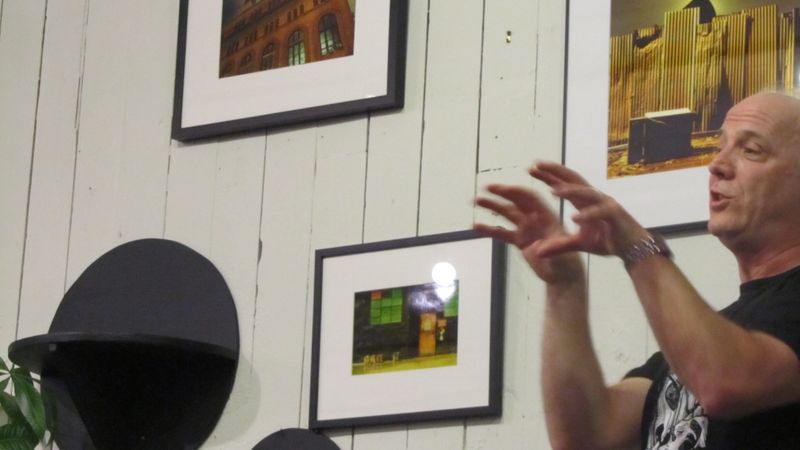
     Readers will include current contributors Sierra Nelson, William Carty, Jeremy Springsteed, Sarah Galvin, Alex Bleecker, and Paul Nelson. Photographer George Ciardi will be showing prints. The We Don't Know Yets will be playing music. Also: I don't know what else, it could be anything!
     Magazines will be for sale! Wine will be for free! 
     Please join us in this pre-emptive pagan event so that together we might end this endless yuletide squabbling, and begin again the beginningless pagan offering. Okay?

11/7/12

Invisible Trolls

Dylan Thomas with several invisible trolls searching his chins for an apple.
     "I far prefer reading other chaps' work to my own: I find it clearer. An hour of me aloud is hell, and produces large burning spots in front of the mind . . . At the mere thought of reading only myself, I begin to feel hunted, invisible trolls shake hands with my Adam's apple."
     - Dylan Thomas in a letter to J.M. Brinnin. This published in Dylan Thomas in America, which three out of three PageBoy Magazine editors agree is a very lovely and very trashy little book.

11/6/12

Vote YES on BS!

High Turnout, Long Lines for PageBoy Vote!

     Don't forget to vote YES on Proposition BS #1: The Legalization and Subsequent Public Funding of PageBoy Magazine!

10/31/12

DT: Damn Tfool

A Damned Fool

     "These poems, with all their crudities, doubts and confusions, are written for the love of Man and in praise of God, and I'd be a damned fool if they weren't."
          -Dylan Thomas.
     Hmm...

10/8/12

Right (T)here

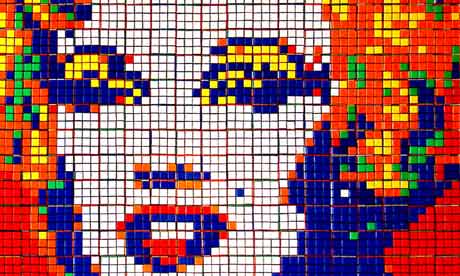
Rubik's Cube Marilyn
     "The problems are solved, not by giving new information, but by arranging what we have always known."
              -Wittgenstein

     The answers are here. Right here. Over there.

9/17/12


"Cold cliff, dead tree,
this knobby-headed me
who thinks there's nothing better than a poem.
I mock myself, writing in dust, and
damn the man who penned the first word
and steered so many astray."      
                       -Ching An (1851-1912)

8/18/12

Ping Pong

Mr. Wang (with broom) representing Ping, and Mr. Shan (sans broom) as Pong.


     8th century Chinese poet Han Shan had this to say about his predecessor, a certain Mr. Wang:

"Mr. Wang's degree says Flourishing Talent.
He loves to find fault with my poems.

He says I don't follow the regulations,
and don't use the right techniques.

He says I don't use the four tones correctly,
and just stick in words any which way.

I laugh at what he calls poetry: a blind man's
rhymes in lukewarm praise of the sun."

     to which Mr. Wang replied:

"Mr. Shan's degree says Master of Subversion.
He loves to find fault with my poems.

He says I don't follow his regulations,
and don't use the right techniques.

He says I don't use the four tones correctly,
and choose my words too carefully.

I laugh at what he calls poetry: a blind man's
rhymes in lukewarm praise of the sun."

8/3/12

Title This Blogpost Please

Please Fill In, Dear Reader

"Anything your reader can do for himself leave to him."
     -Wittgenstein

     It was after reading this Wittgenstein quote that I wrote the following epic poem (published here in its entirety):


7/26/12

Why Don't Hejinian Nunchucks Exist?

Your search - hejinian nunchucks - did not match any image results.
                                (use your imagination)

     "To some extent, each sentence has to be the whole story."
          -Hejinian.
   
     That is, each sentence has to be a hole (read 'rabbit hole') within the, um, story. Not simply le mot juste, but lemon juiced in just the precise Hejinianian way. These such Hejinianianisms are the nonesuch and nunchucks of obsessively paratactic poetry nerds such as haunt the hallowed halls of PageBoy Magazine's corporate hindquarters. It was cold outside.

7/13/12

Get Out of the Way!

How poets should compose.

     "Logic takes care of itself; all we have to do is to look and see how it does it."
          -Wittgenstein.
     Language also takes care of itself. As does poetry. The challenge for poets is not to manipulate language, but to get out of its way.

7/11/12

Irish Football Coach Korg Delusional!

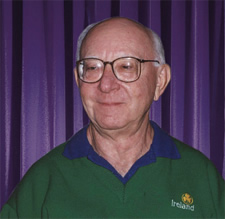
Korg during his time as Poetic Consultant to Ireland's football team (2010). The Irish failed to qualify for the World Cup, though Korg stated famously "won, we've won, before the games've begun." He was sacked shortly thereafter under suspicions that he was "delusional." When asked to respond, he stated simply: "I'm unaware of any accusations against me."

     "Reading poetry does not help us to do anything; it simply helps us to gain a greater awareness of our experiences than we can achieve ourselves."

     "A poem does not offer a copy of, or a comment upon actuality, but a sensation of insight peculiar to itself. Its value does not depend upon its 'truth' to reality, but on its ability to provide, within itself, a clear and coherent experience."

     -both quotes from Jacob Korg in An Introduction to Poetry, sometimes it's nice to be reintroduced.

6/17/12

Monkey Mouth

"In the beginning was the word..."
     Gospel of John.
"In the beginning of heaven and earth there were no words, words came out of the womb of matter."
     Lao Tzu.

     I wish these two would end their endless squabbling over words. The word is that in the beginning was the beginning of the word, but even so there were no words that came out of the womb of matter. Can we all just agree, finally, that words came from monkeys. And note the trends in new poetic writing: the return to monkey mouth!


6/5/12

Reading Lolita in London

Olympia Press's evocative cover. (oh the understatement!)


     "The filthiest book I have ever read. Sheer unrestrained pornography."
          - John Gordon (ed. of the London Sunday Express) in a review of Nabokov's Lolita.
     Obviously Mr. Gordon needs to get better porn, and filthier books! Were the '50s that bleak?
     This quote reminds me of Umberto Eco's comment on the Marquis de Sade (who Gordon obviously never read). It's something to the effect of "The most disturbing thing about Sade's work is that just when you start to get turned on he goes off on some philosophical rant that lasts upwards of 50 pages. How is one to enjoy onesself, there's way too much philosophy!"

5/24/12

Muppets, uh... Critics.

Critics par excellence!

    "I read the poems I could find by the critics, and I pronounced them not very good. I wondered then just what it is about critics that enables them to know so much about poetry when they obviously don't have the faintest idea how it comes about."
          - A.R. Ammons.

5/15/12

Ludwig Lovelace


    "Even to express a false thought boldly and clearly is to have gained a great deal."
           -Ludwig Wittgenstein.

     "I never realized how many lies you have to tell to sell a book."
           -Linda Lovelace.

     It is estimated that Linda Lovelace has sold up to 10 times as many books as Wittgenstein. Interestingly, Lovelace's book Ordeal begins with the wonderfully philosophical line "My name is not Linda Lovelace." If Wittgenstein had enjoyed anything (he evidently didn't), I think he would have enjoyed Lovelace's double entendre. It's a kind of pornographic version of Rimbaud's je est une autre.